
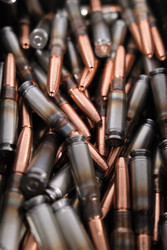
A Deep Dive Into Modern Subsonic Ammunition
Posted by Phantom Defense on Aug 27th 2026
For many shooters, subsonic ammunition begins and ends with the fact that it is quiet and fun to shoot. Pair a heavy bullet with a quality suppressor and you get one of the most enjoyable shooting experiences available. Reduced blast, minimal concussion, and the absence of a supersonic crack have made cartridges like 300 Blackout, 8.6 Blackout, and, more recently, .338 ARC increasingly popular among hunters, recreational shooters, and professional end users alike. As suppressors continue to become more common and accessible, it is only logical that interest in cartridges optimized around sound suppression will continue to grow with them.
While suppression is certainly one of the defining characteristics of subsonic ammunition, we think both its application and its actual capability are still widely misunderstood. If reduced sound were the only benefit, militaries around the world would not have spent decades developing dedicated subsonic cartridges and purpose-built weapon systems around them.
Modern subsonic ammunition represents a fundamentally different approach to solving the ballistic problem. It relies less on raw velocity and more on intelligent projectile design, ammunition consistency, and getting the complete weapon system to work together around a specific use case. Understanding those principles helps explain why subsonic ammunition has remained relevant for decades, why its capabilities have expanded so dramatically in recent years, and why we think there is still a lot of performance left to uncover.
Why Subsonic Ammo Exists
Every weapon system is built around compromise. Long-range rifles sacrifice portability for ballistic performance. Compact carbines generally give up some velocity in exchange for maneuverability. Subsonic weapon systems make a different trade: rather than maximizing velocity, they minimize signature providing enhanced offensive leverage.
When a projectile remains below the speed of sound, it eliminates the ballistic crack produced by supersonic flight. Combined with a quality suppressor, that can dramatically reduce the acoustic signature of the complete weapon system. The real value, though, is not simply that the rifle is quieter. It is the tactical leverage that reduced signature can provide.
This concept has been recognized by militaries for decades. The Russian AS Val and VSS Vintorez were developed in the 80’s around heavy subsonic 9×39 mm ammunition for reconnaissance, special operations, and other applications where reducing signature and preserving the initiative could be more valuable than maximizing velocity or effective range. These were never intended to be benchrest rifles. They were purpose-built suppressed weapon systems optimized around practical field effectiveness.

Subsonic ammunition does not make an engagement invisible, but it can make determining the origin of a shot substantially more difficult. Any delay between recognizing that a shot has occurred and determining where it came from creates leverage.
The same concept translates outside of military use. Anyone who has hunted hogs understands how quickly an opportunity can disappear once an entire sounder solves where a shot originated. Predator hunters see the same thing. Reduced signature can preserve additional opportunities that a conventional rifle may eliminate.
Plus it is fun to hunt with subs and presents unique challenges making it immensely satisfying.

Understanding Subsonic Terminal Performance
One of the most persistent misconceptions surrounding subsonic ammunition is that low velocity automatically means poor terminal performance. That conclusion usually comes from evaluating subs through the same framework we use for high-velocity rifle cartridges.
Supersonic rifle bullets have an enormous amount of velocity available to them. Depending on projectile construction, that velocity can drive rapid expansion, fragmentation, and substantial temporary cavitation. Subsonic projectiles do not have that luxury. At roughly 1,000 fps with the sound barrier defining a hard ceiling on velocity, you don’t have velocity to act as a crutch for mediocre projectile design. The bullet has to do the work.
For purpose-built subsonic ammunition, permanent wound cavity, penetration, expanded diameter, sectional density, retained weight, momentum, and projectile architecture become increasingly important. Most modern purpose-built terminal projectiles approach that problem through one of two primary mechanisms: controlled expansion or controlled fracturing.

Expanding projectiles attempt to increase frontal diameter while retaining enough mass and momentum to continue penetrating, tearing/cutting and disrupting tissue along the way. The goal is to produce a large, repeatable permanent wound path while still reaching the organ structures that matter. Fracturing projectiles take a more aggressive approach, intentionally separating into multiple wound-producing components while generally retaining a base or rear shank that continues penetrating.
We are particularly excited about where fracturing technology is headed. We think fracturing projectiles have an exceptionally high ceiling for terminal effect, and there is still substantial room to experiment with petal geometry, fracture thresholds, retained shank mass, material selection, rotational velocity, and entirely different mechanisms for producing terminal effect. This is an area we are investing in heavily with R&D.

Twenty years ago, much of the available subsonic rifle ammunition consisted of heavy conventional bullets that had originally been designed around completely different velocity windows. They could be accurate, reliable, and quiet, but terminal performance was often limited, and rapid incapacitation placed a much greater premium on exceptionally precise shot placement and disruption of critical structures.
Modern projectile design has changed that considerably. Purpose-built expanding copper monolithic projectiles and controlled-fracturing designs are engineered to work around subsonic impact velocities. Instead of accepting limited terminal performance as an unavoidable consequence of staying below the speed of sound, projectile designers are now building around that constraint.
As far as projectile design has come, we do not think development is remotely finished. We are actively testing projectiles manufactured from different alloys, experimenting with new terminal mechanisms, and evaluating how various materials respond to increasingly aggressive twist rates. One trend we have observed is that harder copper formulations and other alloys can behave particularly well as rotational velocity increases. Faster-than-1:4 twist rates create both opportunities and engineering challenges, and material selection becomes increasingly important as those rotational forces rise.
That opens up a very interesting design space, particularly as projectile manufacturers begin thinking about rotational velocity as part of terminal design rather than simply treating twist as a stability requirement. We fully expect subsonic projectile technology to improve meaningfully over the next several years, and we intend to be one of the companies pushing that envelope.

Heavy Bullets, Sectional Density, and Expansion
There is a reason successful subsonic cartridges generally trend toward heavy projectiles. At subsonic velocity, there is not a surplus of velocity available to burn. Mass and sectional density become useful tools for retaining momentum and obtaining sufficient penetration after the projectile begins doing terminal work.
More projectile mass can be valuable. More sectional density can be valuable. A larger expanded diameter can be extremely valuable. But none of those characteristics exists in isolation.
A projectile that expands to an enormous diameter but cannot penetrate sufficiently is not particularly useful. A projectile that produces spectacular ballistic-gel results but cannot maintain the precision necessary to consistently place that terminal effect into the vitals has an even larger problem.
This is one of the balances that makes subsonic projectile development interesting. We want as much terminal effect as we can reasonably produce, but terminal effect is worthless if pursuing it compromises the projectile to the point that practical accuracy falls apart.
At the end of the day, terminal capability still requires putting the projectile where it needs to go.

Accuracy, Consistency, and Hit Probability
When shooters discuss accuracy, the conversation almost always begins with five-shot groups at 100 yards. That makes sense. A subsonic rifle consistently producing one- or two-inch five-shot groups at 100 yards is an accurate system, and those are absolutely the standards we strive for with our own hunting ammunition.
What a 100-yard group does not tell you is everything that happens after the bullet leaves the muzzle.
Mechanical precision is only one component of practical hit probability. This becomes increasingly important with subsonic ammo because of the long time of flight. Small differences in muzzle velocity create differences in flight time, and those differences begin showing up as increasing vertical dispersion as distance grows.
That is why we care so much about velocity consistency.
A complete weapon system producing 3 MOA with exceptionally consistent ammunition may produce a higher hit probability at extended range than a mechanically superior rifle firing inconsistent ammunition. That does not mean a 3 MOA rifle is preferable to a 1 MOA rifle. It is not. Give us a one-inch rifle and single-digit velocity SDs every time.
The point is that practical hit probability is the product of the complete system. Mechanical group size matters, but so do velocity consistency, the quality of the firing solution, range estimation, wind, stability, and the shooter’s ability to execute the shot. A five-shot group at 100 yards captures only part of that equation.
A Quick Note on BC SD
Ballistic coefficient standard deviation is another subject that we think is misunderstood when applied to extended-range subsonic shooting.
Ballistic coefficient absolutely matters. It describes aerodynamic deceleration, and at conventional long-range rifle distances differences in BC can become a major contributor to dispersion because the projectile has shed a substantial percentage of its original velocity and small drag differences have had hundreds of yards through which to accumulate.
Subsonic ammo is operating in a completely different sensitivity regime.
A well-designed subsonic projectile may lose only around 10% of its muzzle velocity over 300 yards. Because BC acts through aerodynamic deceleration, there simply is not much total velocity loss available for realistic shot-to-shot BC variation to act on. Muzzle-velocity variation is different because it changes the trajectory from the instant the projectile leaves the barrel.
That is why our modeling continues to show muzzle-velocity consistency having a substantially larger influence on vertical dispersion than realistic projectile-to-projectile BC variation throughout practical subsonic distances.
There is another layer to this that gets particularly interesting near Mach 1. Most high-performance subsonic rifle ammunition operates somewhere around Mach 0.9 to 0.95, directly on the lower edge of the transonic drag rise. Aerodynamic drag is changing rapidly in this region, and many modern heavy subsonic projectiles do not perfectly follow either the traditional G1 or G7 reference drag curve throughout their entire flight.
That matters because ballistic coefficient is not a physical constant in the same sense as projectile mass or diameter. It is a number used to scale a standardized reference drag function so that the model approximates the behavior of the actual projectile. When the real projectile does not closely follow that reference curve, one constant BC becomes an imperfect description of the flight.
Near Mach 1, muzzle velocity and the apparent BC calculated from downrange data can also become partially coupled. A faster shot and a slower shot may travel through slightly different portions of the steep transonic drag curve. When both trajectories are then forced back into a conventional constant-BC model, the solver can return different apparent BC values even if there is very little true aerodynamic difference between the projectiles themselves.
In other words, some apparent subsonic BC SD may actually be muzzle-velocity SD wearing a disguise

.
We are going to publish a separate technical paper that goes considerably deeper into that subject, including Mach number, G1 and G7 model limitations, velocity-decay fraction, true versus apparent BC variation, and why we believe muzzle velocity is the dominant ammunition-driven source of vertical dispersion inside practical subsonic ranges. If you are an autistic nerd keep an eye out for this.
The practical lesson is much simpler. We would not treat a published G1 or G7 BC as the final authority for a serious subsonic firing solution. Start with the best muzzle-velocity data you can collect, use our published SDs as a starting point, and then verify the actual trajectory with your rifle and ammunition.
If you care about making consistent impacts at 200, 250, 300 yards and beyond, walk the system out on known-distance targets and collect real dope. Depending on the facility available, gathering actual center-of-group elevation corrections in approximately 20-yard increments can produce an extremely useful empirical trajectory map.
The objective is not to endlessly manipulate a BC until a solver happens to agree with a few impacts. The objective is to measure what the complete rifle and ammunition system actually does.
You are not necessarily determining the one “perfect BC” by doing this. You are validating the firing solution, which is ultimately more useful. With subs, where neither G1 nor G7 may perfectly represent the projectile’s actual drag behavior throughout its flight, we place a lot of value on measured trajectory data.
The goal is still straightforward: small groups, low velocity variation, a predictable trajectory, and enough real-world data that the first round goes where you expect it to go when you need it to.
Military Subsonic Systems Offer an Interesting Reality Check
The Russian AS Val and VSS provide a useful historical perspective because they challenge the idea that a rifle has to print tiny benchrest groups to have meaningful capability at distance.
These systems are generally not known for extraordinary mechanical precision by modern precision-rifle standards. Practical accuracy is commonly described in the neighborhood of 2–4 MOA depending on the rifle, ammunition, condition, and other variables. Yet the weapon family was built around practical use of heavy subsonic ammunition well beyond the distances many shooters instinctively associate with subs, with the VSS in particular associated with engagement capability extending to several hundred meters.

That does not mean 4 MOA is ideal. Again, we want better. What it illustrates is that practical effective range and 100-yard mechanical group size are related, but they are not identical concepts.
Reliable ammunition, consistent trajectory, appropriate optics, correct range information, wind calls, shooter skill, and mechanical precision all contribute to whether a first-round impact occurs. The complete system matters.
We routinely produce subsonic hunting ammunition capable of one and two inch five-shot groups at 100 yards, and we devote just as much attention to minimizing velocity variation because both characteristics continue paying dividends as distance increases.
Realistically, modern purpose-built subsonic systems are already very capable of first-round impacts at 250–300 yards. We have repeatedly taken animals at those distances with our own subsonic ammunition. That capability is not theoretical to us; we have seen it in the field and will have plenty of upcoming opportunities to show some of that off.
Building Better Subsonic Systems
Subsonic performance is not determined by any one specification. Large expansion is valuable, but not if it comes at such a cost to precision that consistently hitting the intended target becomes difficult. High sectional density is valuable, but only if projectile construction allows it to translate into useful penetration. Fast twist can unlock terminal mechanisms that may be difficult to achieve otherwise, but projectile material and construction have to tolerate the rotational environment. Fracturing can create exceptional terminal effect, but the projectile still has to arrive exactly where it needs to.
The best subsonic ammunition is therefore not built by maximizing one number. It comes from balancing mechanical precision, velocity consistency, projectile architecture, mass, sectional density, twist rate, stability, terminal performance, and weapon-system reliability.
That complete-system approach is also one reason we are excited about what is beginning to happen on the competitive side of subsonic shooting.
Several members of our team will be shooting the Silent but Deadly match here in Utah, a subsonic PRS-style match hosted by Next Shot Precision. We are using the opportunity to put some developing subsonic SKUs through a very different kind of testing, and we are super stoked on the format.
Competitive environments have a way of finding problems quickly. We have seen that with PRS and ELR. When equipment gets placed against the clock, at changing distances, from imperfect positions, and with actual consequences for misses, it becomes much more difficult to hide weaknesses behind one impressive specification.
That kind of pressure is good for the industry because it rewards consistent ammunition, good ballistic solutions, reliable equipment, and complete-system thinking. We think competitive opportunities like these can play an important role in closing the gap between peak terminal performance and peak practical accuracy.
The competitive side of subsonic shooting is just getting started. You can expect to see subsonic gas-gun competitions and practical precision or hunting-style formats that borrow concepts from PRS and NRL Hunter. We plan to help facilitate this.
Final Thoughts
Looking at where subsonic technology stands today compared with even a decade ago is pretty dang cool. Purpose-built expanding and fracturing projectiles have dramatically changed what these cartridges are capable of, modern suppressors have changed the weapon systems built around them, and shooters are beginning to push subsonic ammunition farther and more seriously than they have in the past.
At the same time, there is still an enormous amount we are actively learning. Projectile materials, twist-rate interactions, terminal consistency, drag modeling, manufacturing tolerances, and the balance between maximum terminal effect and maximum precision all present challenges that have not been completely solved. To us, that is not a knock against the category. Challenge means opportunity. Every problem we uncover gives us another variable to understand, another assumption to test, and another opportunity to make the ammunition better.
That is a big part of why we are so excited about where subsonic shooting is headed. Increased suppressor adoption will naturally bring more shooters into the category, and emerging competitive formats will begin putting these systems under a different kind of pressure. That means more rounds fired, more data collected, more weaknesses exposed, and more incentive for projectile designers, ammunition manufacturers, rifle builders, and suppressor companies to improve the complete system.
We are extremely proud of what our subsonic ammunition is capable of today, but we have no illusion that the work is finished. If anything, what we have learned so far has made us more interested in the problems that remain. We are looking forward to continuing to experiment, test ideas, break things, learn from them, and see just how capable modern subsonic weapon systems can become.