
A 300 Blackout Philosophy
Posted by Phantom Defense on Jul 21st 2026

While discussing 300 Blackout with end users we often like to use the terms efficiency and leverage to describe the capabilities we are able offer with our ammunition.
Thinking in Terms of efficiency and leverage we can evaluate every weapon system as a collection of compromises. Weight, barrel length, recoil, magazine capacity, terminal performance, and signature all exist in tension with one another. Ultimately the goal being to make as few compromises as possible for a predetermined expected range of use cases. Generally speaking, getting exceptional performance in one area means accepting compromises somewhere else.
With our ammunition 300 Blackout is able to cast a pretty wide net in terms of utility because it provides a high degree of offensive upside with subsonic ammo while also offering supersonic performance that is legitimately satisfactory for a very high percentage of real world engagements, all within a footprint that is often more compact than incumbent weapon systems.
Reactive Problems and Initiated Problems
The distinction around utility between supersonic and subsonic ammunition is really a distinction between two different types of engagements.
Defensive encounters are almost always reactive. Someone else has forced the engagement upon you, and your objective is to stop that threat as efficiently as possible. Signature reduction has value, but preserving surprise is no longer the defining variable because the fight has already begun.
Initiated engagements are fundamentally different. Whether the mission is a military direct-action operation, a law enforcement mission requiring discretion, or a hunter working through a sounder of feral hogs or engaging in depredation, the engagement begins on your terms. Preserving the initiative becomes part of accomplishing the objective itself.
Supersonic ammo provides efficiency and subsonic ammo provides engagement leverage.
Supersonic Ammo as an Efficient Defensive Tool
Supers are efficient both in terminal capability and in performance for a given barrel length. Our 120 gr Specter is pushing right up to just north of 2300 fps in a 10.3” MK18 and is doing just shy of 2k fps in a 5.5” sig rattler. Just with the rattler you are able to beat the lethality window of 5.56 in a 10.3” rifle all with ammo that is within standard operating pressures. The 5.5” Sig Rattler itself was born out of an interest in primarily supersonic performance from a compact weapon system.

(Here’s a link to a cool video about the MCX Rattler platform and the requirements that drove the origination of the weapon system)
Since the development of the rattler platform our ammunition has come a long way, the capabilities you can get out of 300 blk have been greatly enhanced.
One of the most common questions we receive is whether subsonic ammunition could be used for home defense. The answer is yes. Modern expanding subsonic projectiles are exceptionally capable defensive rounds, and anyone suggesting that subsonic ammo is ineffective simply because they travel below the speed of sound fundamentally misunderstands terminal ballistics.
Ultimately, supers generally will result in more rapid and immediate threat mitigation than subs (of course shot placement remains king, it’s very difficult for hostiles to continue fighting after intimate relations between subsonic 300 blk and their medulla oblongata). Higher impact velocities produce more forgiving terminal performance across a broader range of engagement conditions. Kinetic energy, while not a terminal mechanism in and of itself, does have the capacity to literally knock targets over and contributes to rapid incapacitation and tissue disruption. Using supers in a home defense type of engagement also reduces the likelihood of excessive penetration through common building materials compared to many heavy subsonic projectiles, which often surprises people.

Many assume slower bullets penetrate fewer walls. In practice, the opposite is frequently true. Heavy subsonic projectiles tend to retain their mass and momentum as they pass through drywall and other common building materials, while lightweight, rapidly expanding supersonic rifle bullets often shed energy much more quickly. Every projectile behaves differently, but it’s an important consideration when selecting defensive ammunition.
All that to say, plenty of guys on our team are still using subs in their bedside guns but supers no doubt are providing a step up in ballistics and do so in pretty small guns.
Subsonic Ammo as a High Leverage Offensive Capability
If supers are optimized for efficiency, subsonic ammo is optimized for leverage.

Subsonic ammunition is moving slower than the speed of sound. Removing the supersonic crack results in increased sound signature reduction which makes it substantially more difficult for those being engaged to determine where the shooter is actually located if they even realize they are being engaged at all. Even after the first shot, an opposing force may recognize they are under attack while still struggling to orient on the source of that attack. That uncertainty delays an effective response, preserves the initiative, and creates opportunities that simply don’t exist with conventional supersonic rifle ammunition.
Historically, this capability has made subsonic ammunition valuable in deliberately initiated operations. Reduced-signature weapon systems have been employed for tasks such as sentry elimination and other direct-action missions where maintaining surprise materially improves the probability of success.
The same principle applies outside of military engagements, hunting feral hogs for example. Even simply used to initiate conflict, the initial leverage that subsonic ammo can provide can result in force multiplication.
The value of subsonic ammunition is not that it’s “Hollywood quiet”, (although it can get very close) it’s that one shot doesn’t necessarily cost you the next one, that’s leverage.

Thought Process for 300 Blk Rifle Setup
We are often asked what the “best” barrel length is for 300 Blackout. There really isn’t one, instead we’ll give you a brief framework to think about how much barrel length you need to get the performance you want.
First off, if you are looking at 300 Blk as a subsonic first capability we’d recommend you go as short as you can or as is ergonomically reasonable. We really enjoy weapon systems in the 5.5”-7” range such as the Rattler or the Honeybadger.
If supersonic performance is a priority then determine how far you need to be able to shoot and then make sure that you are getting enough velocity at the muzzle to keep 120 gr Specter above 1400 fps at your max range of engagement. The reason being that the Barnes TAC TX projectile that we use in that round requires a minimum impact velocity of about 1400 fps to expand reliably.
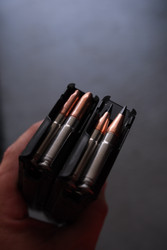
One magazine optimizes the rifle for efficient, decisive terminal performance from an exceptionally compact platform.
The other optimizes the same rifle for deliberately initiated engagements where reduced signature creates tactical leverage that cannot be replicated simply by adding more velocity.
Understanding how to use the cartridge effectively allows you to get the most out of the platform because it gives you access to capabilities that are rarely found together in the same weapon system.
The vast majority of close-quarters engagements occur well inside 100 yards. Within that envelope, 300 Blackout is exceptionally difficult to beat. It delivers outstanding terminal performance from an extremely compact platform, while retaining an effective supersonic engagement envelope far beyond the distances at which most close-quarters problems are actually solved.
300 Blackout has been around for over a decade offering both subsonic and supersonic performance. Our goal at Phantom has been to build on the performance legacy of the cartridge and to expand 300 Blackout capabilities both on the subsonic and supersonic side.
