
Viability of Supersonic 8.6 Blackout
Posted by Phantom Defense on Feb 25th 2026
An Emerging Supersonic Architecture in Compact Large-Frame Platforms
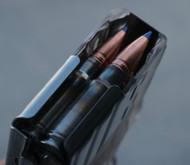
8.6 Blackout is most often discussed as a subsonic cartridge. That emphasis makes sense — it is exceptionally well suited to suppressed, low-signature roles — but it does not tell the entire story. Supersonic 8.6 Blackout represents a deliberate engineering effort to deliver meaningful terminal authority from compact large-frame platforms.
Let’s look at battle rifles:

Large-frame battle rifles are not selected casually, historically. They are chosen when greater ballistic authority is required — whether that means improved barrier performance, deeper penetration, increased terminal effect, or maintaining performance margins against intermediate cover. In man-to-man combat, ballistic overmatch can refer to the ability to impose decisive terminal effect within realistic engagement distances while retaining enough performance margin to account for imperfect shot placement, environmental variables, and intermediate barriers, and armor. The US Army specifically defines it as concept where my (insert lethality system here) can willfully and without prejudice or luck defeat your (insert your protective system here). In realistic practical applications, large-frame rifles are most commonly employed inside 300 meters (but its fun to shoot them lots further).
Beyond professional use, these same cartridges frequently serve dual roles. The cartridges that modern large-frame platforms are often configured around also provide capability of defensive utility alongside medium and large game hunting.
Large Frame Cartridge Landscape
If the requirement is stretching distance, minimizing wind drift, and maintaining aerodynamic efficiency well beyond 600 meters, cartridges like 6.5 Creedmoor make sense. They perform extremely well in 14.5” barrels (You’ll see a whole writeup soon on short barrel 6.5 CM and 6 CM performance) and it truly shines in 16–22” gas guns where velocity and ballistic coefficient can be fully leveraged.
If the requirement is strong terminal authority from a more compact large-frame platform, .308 remains highly effective in 12–16” barrels. It has proven viability in 13” systems such as the assaulter variant of the HK417 and it maintains meaningful performance inside realistic engagement distances. There’s a ton of documentation around how JSOC has deployed the hk417 weapon system in the past.

8.6 Blackout occupies more deliberate window being purpose built for 12-inch and shorter barrels. When subsonic performance is the primary objective, shorter barrels — 6 –10 inches — make excellent sense. The cartridge was designed around heavy-for-caliber projectiles that deliver significant mass and diameter at low velocity with minimal signature. The amount of damage that can be done with these subs is extremely impressive and reduced signature performance is still massively underrated by civilians in our collective opinion. When looking at the cartridge from the perspective of supersonic performance, 12 inch barrels are the sweet spot.

The 300 Meter Problem
Kevin Brittingham and Q deserve credit for clearly articulating what has often been referred to as the “300 meter problem.” The premise was straightforward: most realistic engagements occur inside 300 meters, yet many cartridges and rifle configurations are optimized for distances well beyond that envelope. In doing so, they often sacrifice efficiency, compactness, or signature reduction inside the distances that matter most. The team at Q built a cartridge around a defined operational window rather than abstract ballistic extremes. The emphasis on short barrels, suppressor-first design, and system efficiency laid the foundation. As the cartridge matures, manufacturers across the industry are now refining projectile design, pressure curves, and supersonic optimization within that original framework. With a 12”, 8.6 Blackout supers are capable of delivering substantial muzzle energy and retains meaningful capability well inside the distances most large-frame rifles are actually employed. Shorter than 12 inches, velocity declines predictably but does not collapse. Inside 300–400 meters, supersonic effectiveness remains intact. With our 185 gr Genie 2 utilizing the Barnes TTSX projectile and producing a muzzle velocity of approximately 2320 fps in 12” barrels you start to enter the transonic window roughly between 800 and 900 yards depending on environmental conditions. To be clear though, this is not intended to be a 900 meter solution but rather something that delivers large-bore terminal authority from compact platforms without sacrificing flexibility.

Phantom’s Genie 2 represents our current benchmark for supersonic 8.6 performance. From a 12-inch barrel, the 185-grain projectile produces a velocity of approximately 2320 feet per second, providing 2211 foot-pounds of energy at the muzzle. With a G1 ballistic coefficient of 0.432 and a sectional density of 0.231, it maintains meaningful energy inside moderate distances.
Inside 300 yards, energy remains above 1300 ft-lbs. Even at 500 yards, nearly 900 ft-lbs remain. The cartridge remains supersonic well past realistic engagement distances, transitioning between roughly 800 and 900 yards. Elevation remains predictable, and — as with nearly all intermediate systems — wind becomes the dominant variable as distance increases.

What distinguishes 8.6 Blackout is not extreme-range efficiency. It is diameter and system intent. A .338 diameter projectile presents significant frontal surface area. Some of the most violent exit wounds we have ever seen have been produced by 8.6 Blk supers. When projectile design is executed correctly, terminal authority inside realistic distances is substantial. That geometry becomes especially relevant in compact systems where velocity margins are inherently compressed.
It is also worth briefly addressing twist rate. The .338 TTSX used in Genie 2 was originally engineered for higher-velocity magnum applications in 338 LPM. In many ways this projectile is neutering supersonic performance potential. It’s use in 8.6 Blackout is supported by the 1:3 twist rate commonly associated with the cartridge. The extreme rotational velocity assists in mechanical expansion performance at velocities below the projectile’s original design window. This projectile is the best supersonic projectile currently available (we’re testing several dozen new designs) but it in no way supports the top end of what the cartridge is capable of.

For the purposes of this article, that is where the twist-rate discussion ends. We recognize there is significant interest in how extreme twist rates impact performance. We have compiled extensive internal data and will publish further findings once 1:6 barrels are thoroughly tested. Ultimately, twist rate is not about declaring a universally “correct” number; it is about selecting the appropriate rate for a specific use case and you have some tradeoffs in both directions. In 8.6 Blackout, twist rate selection is a system decision.
Payload Capacity and the Advantage of .338 Diameter
When looking at the final piece of how 8.6 BLK can provide utility we must touch on payload capacity. One of the most under-discussed aspects of 8.6 Blackout is payload capacity.
Diameter is not only a terminal geometry variable — it is a design envelope variable. A .338 diameter projectile provides significantly more internal volume than .30 caliber or 6.5mm projectiles. That additional volume can be harnessed in multiple ways depending on mission requirements.
In supersonic configurations, increased internal capacity allows for more sophisticated projectile construction. Barrier-blind monolithic designs, hardened penetrators, controlled-expansion cavities, and armor piercing incendiary designs all benefit from additional material and structural room. When discussing ballistic overmatch — particularly against intermediate barriers or protective systems — that design headroom becomes meaningful.
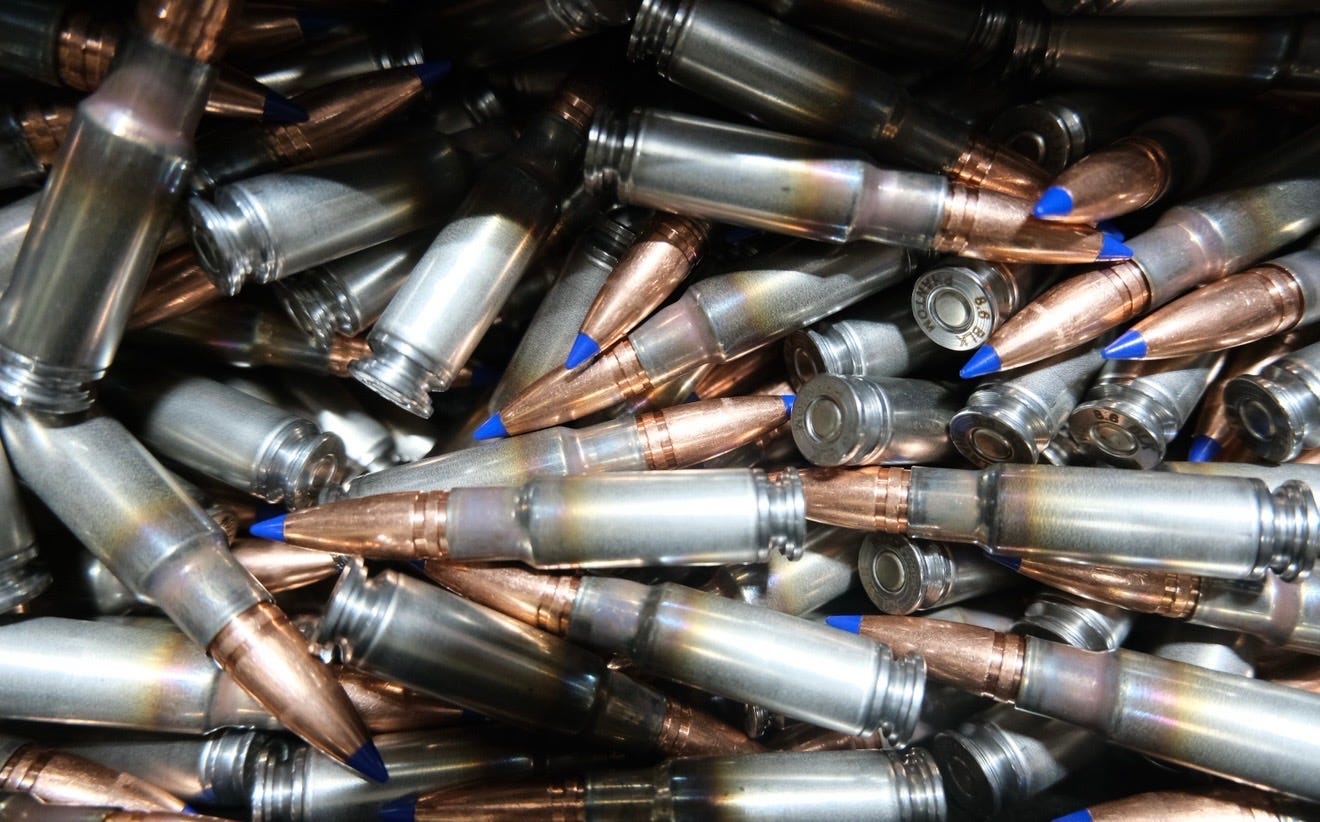
Armor interaction is driven by impact velocity, projectile construction, and sectional density. A larger diameter projectile with sufficient structural integrity can carry more penetrative material or maintain more mass through intermediate obstacles. While armor-piercing capability ultimately depends on specific projectile design the physical envelope provided by .338 diameter allows for engineering solutions that smaller projectiles cannot accommodate as easily.
This is an area where 8.6 Blackout differentiates itself from smaller-diameter systems operating in similar velocity regimes. The projectile envelope that the cartridge provides allows substantial design flexibility — in both supersonic and subsonic configurations
Still an Emerging Performance Envelope
Supersonic 8.6 Blackout is still in its infancy. In a 12-inch barrel, it delivers supersonic performance that is legitimately impressive inside practical distances. In barrels shorter than 12 inches, it retains sufficient supersonic capability to remain effective within 300–400 meters.
For many users, 8.6 will remain primarily a subsonic-first cartridge. That is a significant part of its value proposition and most realistic combat engagements happen well within a distance that subsonic ammo maintains effectiveness. Low-signature subsonic performance is still widely underestimated and misunderstood. However, the cartridge’s flexibility contributes to making it compelling.

NAS3 case technology has further expanded the supersonic envelope, contributing to the velocity and consistency we are able to achieve in loads like Genie 2. Supersonic performance matters because it balances the system. It ensures that 8.6 Blackout is not confined to a niche subsonic role. It provides reach beyond purely low-velocity applications while preserving the large-bore geometry that defines its terminal character. As projectile design matures and purpose-built supersonic bullets enter production, the supersonic side of 8.6 Blackout will continue to evolve.