
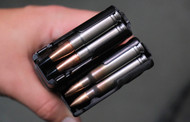
A Requirements-Driven Comparison of 300 Blackout and 5.56×45 NATO
Posted by Phantom Defense on Feb 11th 2026
Operational Requirements Drive Cartridge Selection
Discussions about cartridge selection for the AR-15 platform often drift toward ideology. Velocity numbers are cited in isolation. Energy figures are compared without regard to terminal impact. Trajectory is emphasized while thresholds for terminal effects are ignored. The result is a debate that lacks analytical value when cartridges are evaluated outside their intended use case or under unequal performance constraints.
Before evaluating ballistic charts, energy tables, or expansion thresholds, pause and answer a more important questions and determine the output requirements you have for your short barrel rifle:
What do you actually expect your AR-15 to do?
-
What is the maximum realistic distance you expect to engage targets?
-
At what range are you comfortable accepting reduced terminal reliability?
-
Are you optimizing the cartridge for the barrel, or the barrel for the cartridge?
-
Would the ability to run subsonic ammunition expand your use case?
-
How confident are you in reading wind beyond 300 yards?
-
Is recoil management or training cost part of the equation?
The cartridge decision cannot be separated from these answers.
Too often, caliber debates begin with internet consensus and then work backward to justify a position. That approach produces conclusions detached from reality. A cartridge that excels in a 16–20 inch rifle may behave very differently in a 10.5-inch configuration. A round optimized for fragmentation at high velocity may not retain that behavior when barrel length is reduced.
If you do not first define:
-
The barrel length you intend to run
-
The distances you realistically expect to engage
-
How much terminal margin you want beyond typical engagement distance
— then any cartridge comparison becomes abstract.
This paper assumes you are evaluating rifles in the 10.5”–12.5” range and are seeking reliable, barrier-blind performance with measurable terminal margin. Within that defined envelope, the comparison becomes meaningful.

To set the stage clearly, this analysis focuses only on the gap between 10.5-inch and 12.5-inch barrels.
Outside this range, the answer is largely settled.
Barrels longer than 12.5 inches strongly favor 5.56×45 NATO.
Barrels shorter than 10.5 inches strongly favor 300 AAC Blackout.
The debate lives in between.
The question is not which cartridge is universally superior. The question is:
Which cartridge preserves more terminal and ballistic margin inside the 10.5”–12.5” decision window?
Establishing a Fair Benchmark
To evaluate this honestly, 5.56 must be given every reasonable advantage.
From a 10.5-inch barrel, the benchmark load is a short-barrel-optimized Phantom Defense 70-grain solid copper TSX-class projectile in NAS3 casing, producing approximately 2,550 fps at the muzzle. (This round will potentially be commercialized shortly pending further testing)
From a 12.5-inch barrel, that same 70-grain TSX produces approximately 2,680 fps. We also include the Phantom Defense 77-grain OTM NAS3 load at approximately 2,620 fps.

Opposing these is the Phantom Defense AAC Blackout 120-grain Specter, producing approximately 2,312 fps from 10.5 inch barrels and 2,350 fps from 12.5 inch barrels.
All loads evaluated are modern, sbr optimized designs. This is not a comparison between compromised and idealized cartridges. It is a comparison between cartridges operating at their contemporary performance ceiling.

Diameter and Terminal Mechanics
With monolithic copper projectiles, terminal performance is governed primarily by permanent cavitation — the physical crushing and displacement of tissue. These bullets retain nearly all their mass and expand in a controlled manner. They do not rely on fragmentation.
In that context, diameter matters.
A .30-caliber projectile begins with significantly greater frontal area than a .22-caliber projectile. When expansion occurs, the larger starting diameter compounds into a larger expanded frontal surface. The resulting wound channel is correspondingly larger for a given depth of penetration.
This is not a philosophical argument. It is geometric.
Bigger bullet. Bigger expanded diameter. Larger permanent cavity.
As velocity drops and expansion becomes more conditional, this diameter advantage becomes increasingly important.
10.5-Inch Barrel: Where Expansion Windows Separate
The most consequential variable in short barrels is not muzzle velocity. It is minimum expansion velocity for a given projectile selection. Here we are being very fair by looing at projectiles that balance reliable terminal performance windows with optimized ballistic capability.
The 70-grain TSX requires approximately 1,900 fps impact velocity for reliable expansion. From a 10.5-inch barrel, this threshold occurs just under 300 yards. Beyond that distance, the projectile increasingly behaves as a non-expanding solid.
The 77-grain OTM can exhibit upset behavior below 2,100 fps (down to 1900 fps), but reliable fragmentation generally occurs above approximately 2,100 fps. From a 10.5-inch barrel, that reliable window also closes near 300 yards.
The 120-grain 300 AAC Blackout Specter expands reliably down to approximately 1,350–1,400 fps. From a 10.5-inch barrel, that threshold extends to roughly 500 yards.

Even though realistic engagements are typically inside 300 yards, this 300 Blackout cartridge retains approximately 200 yards of additional expansion margin. That margin matters when impact velocity decays, environmental conditions vary, or barriers are introduced.
12.5-Inch Barrel: Does Velocity Close the Gap?
Increasing barrel length to 12.5 inches improves 5.56 performance. With updated velocities of 2,620 fps for the 77 OTM and 2,680 fps for the 70 TSX, muzzle energy rises accordingly.
From 12.5 inches, the 120-grain Specter produces approximately 1,472 ft-lbf of muzzle energy. The 77-grain OTM produces approximately 1,174 ft-lbf, and the 70-grain TSX approximately 1,117 ft-lbf.
The velocity increase is meaningful. The structural difference remains.
At 300 yards from a 12.5-inch barrel, elevation holds converge near 1.5 MIL for all three loads. Wind holds remain just under or near 1 MIL in a 10 mph full-value wind. Trajectory differences are modest and easily managed with modern optics.
The divergence occurs in terminal velocity.
At 300 yards, the 70-grain TSX is approximately 1,915 fps — effectively at its expansion threshold. The 77-grain OTM also is below its more reliable 2,100 fps fragmentation window at this distance. The 120-grain Specter remains near 1,950 fps, comfortably above its 1,350–1,400 fps expansion floor.
At 500 yards, the difference becomes decisive. The 120-grain Specter remains expansion-capable at approximately 1,580 fps, retaining roughly 427 ft-lbf of energy. The 77-grain OTM and 70-grain TSX are both below their reliable terminal windows at that distance.
Even with improved muzzle velocity, 5.56 retains reliable expansion to approximately 300 yards. The 300 AAC Blackout retains reliable expansion to approximately 500 yards.
The gap narrows slightly at 12.5 inches. It does not disappear.
Wind as the Real Discriminator
Ballistic coefficient further clarifies the discussion. The 77-grain OTM projectile carries a G1 BC of approximately 0.372. The 120-grain Specter carries a G1 BC of approximately 0.358. The 70-grain TSX carries a G1 BC of approximately 0.323.
Trajectory differences between these loads are modest inside 400 yards. Elevation is deterministic. It is dialed or held precisely.
Wind is not deterministic.
At 500 yards in a 10 mph crosswind, wind holds approach 1.6–1.9 MIL across these cartridges. By 600 yards, wind holds exceed 2 MIL. At these distances, first-round impact probability is governed more by wind estimation than drop.
However, wind resistance only matters if the projectile still performs terminally. At distances where wind becomes the dominant ballistic variable, only the 300 AAC Blackout projectile remains within its designed expansion window.
Wind advantage without terminal viability does not translate into practical effectiveness.
A Note on Subsonic Capability
This paper focuses primarily on supersonic 300 Blackout performance in order to make a direct comparison with 5.56×45 NATO under equal ballistic conditions.
However, it would be incomplete not to acknowledge a structural advantage unique to 300 AAC Blackout: true subsonic versatility.
Unlike 5.56×45 NATO, 300 AAC Blackout was designed from inception to operate effectively in both supersonic and subsonic regimes from the same platform. From a systems perspective, this flexibility expands capability without requiring a different rifle, bolt face, or magazine system. The shooter gains an additional operational envelope simply by changing ammunition.
While this analysis intentionally centers on supersonic performance to keep the comparison equitable, subsonic versatility remains a material point in favor of 300 Blackout when evaluating short-barreled AR-15 platforms holistically.

Margin in the Decision Window
The purpose of this analysis is not to dismiss 5.56×45 NATO. In barrels longer than 12.5 inches, it remains the most efficient and appropriate choice. In barrels shorter than 10.5 inches, 300 AAC Blackout operates comfortably within its design intent while 5.56 margins collapse.
Inside the 10.5”–12.5” window, the comparison becomes one of margin.
5.56 relies heavily on velocity. Its expansion and fragmentation behavior compress as barrel length shortens.
300 AAC Blackout relies on mass, diameter, and lower expansion thresholds. Its performance envelope degrades more slowly as velocity drops.
The difference is not dramatic inside 200 yards but it does become meaningful at the edges of the realistic engagement envelope.
A caveat to add here, this comparison is not perfect! Elevation and environmental conditions can change things a little bit. Also, barrels vary in velocities they produce! The numbers outlined here are very much indicative of the average. In total and at the very least we hope that this comparison can serve as a frame work you can use to make decisions around deploying different cartridges in different environments and for different use cases.
